












US and China seek to repair damage from tariff war that sent trade into a freefall
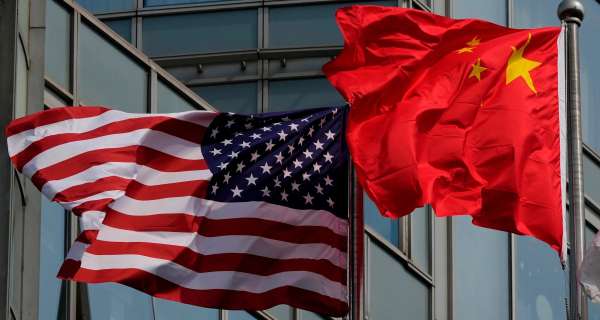
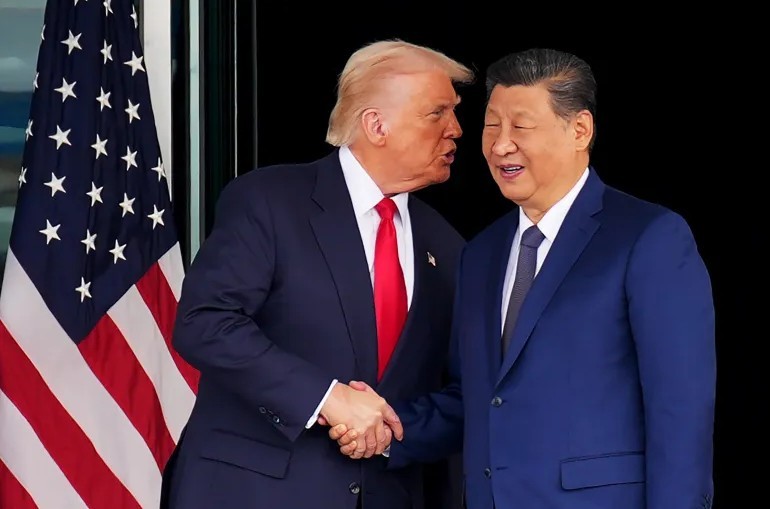
WASHINGTON (AP) — During a tumultuous 2025, the United States and China proved how much they could hurt each other in a trade war. Now Presidents Donald Trump and Xi Jinping are meeting in Beijing to repair some of the damage.
A decade of conflict between the world's two biggest economies has left U.S.-China trade greatly reduced from the boom times of the 2000s and 2010s, forcing companies to regroup. Many American firms have shifted production out of China to countries like Vietnam and India. And Chinese firms have scrambled to find new customers in Europe and Southeast Asia.
But the two countries are finding that they still need each other. "The idea of somehow China being totally independent of us and us being totally independent of China, I think, is a fiction,'' said financier Wilbur Ross, who served as U.S. Commerce secretary in Trump's first term.
This week's summit is primarily about keeping the economic relationship stable, with only modest policy announcements expected. A trade truce reached last October likely will be extended, while China may announce plans to buy American soybeans, beef and Boeing airplanes. U.S. officials also have teased the creation of a Board of Trade.
Watching closely will be American farmers who were shut out of the Chinese soybean market for most of 2025, as well as U.S. manufacturers who lost access to China’s rare earth minerals they need to make everything from smartphones to fighter jets.
In China, manufacturer Michael Lu is hoping the Xi-Trump summit will herald more positive signs. Chances of U.S.-China commerce going back to the roaring trade of 15 years ago may be slim, but factory owners in China are expecting for at least some improvements. “The U.S. used to be a more stable market,’’ said Lu, founder and CEO of gift box producer Brothersbox in the southern city of Dongguan.
A freefall in U.S.-China trade
Before Trump began slapping taxes on Chinese imports in 2018, the average U.S. tariff on China stood at 3.1%. Now, even after coming down from the triple-digit levels they briefly hit last year, they are still at almost 48%, according Chad Bown of the Peterson Institute for International Economics.
In 2016, the United States did more business with China than any other country. Trade between the two countries — exports plus imports — accounted for more than 13% of America’s trade with the rest of the world. By last year, China’s share had been halved to 6.4%. Mexico and Canada had leapfrogged China to become the top two U.S. trading partners.
The problem with the pre-Trump U.S.-China trade boom was that it was so lopsided. China sold far more to the United States than it bought. The U.S. deficit in the trade of goods and services with China peaked at $377 billion in 2018. Last year, it was down to $168 billion, the lowest since 2004.
Still, China has exported so much to other markets — Southeast Asia and Europe, in particular — that it recorded a record global trade surplus of $1.2 trillion last year.
Chinese companies find workarounds
The American government’s statistics probably overstate the drop in U.S.-China trade. Many Chinese companies have relocated to Southeast Asian countries like Vietnam and Thailand and now send their stuff onto the United States, dodging U.S. tariffs. The Trump administration wants to crack down on these “transshipments.’’
As China sent fewer goods to the United States last year, goods imports from Southeast Asia surged — up 42% from Vietnam, 44% from Thailand, 24% from Indonesia.
“It would be wrong to think that China is no longer relevant for the U.S. market,’’ said Zongyuan Zoe Liu, senior fellow for China studies at the Council on Foreign Relations. “Chinese goods are still coming into the U.S.’’
Velong Enterprises, which was founded in China’s southern Guangdong province in 2002 and makes kitchen gadgets and grilling tools for Walmart and other U.S. retailers, diversified its supply chain in the years since Trump’s first term in the White House in order to serve U.S. customers, including by adding production capacity in Cambodia and India.
“Most serious manufacturers did not simply ‘leave China,’” said Velong CEO and founder Jacob Rothman. “Instead, they built multi-country supply chains around China.”
Contending with erratic tariffs
The trade war with China has taken a toll on Appu Jacob Varghese, who owns Zion Foodtrucks, a small food truck manufacturer outside Colorado Springs that imports Chinese equipment for its trucks.
“Last year,’’ Varghese said, “a lot of my hair turned white.’’
What tormented Varghese was the erratic way Trump imposed his taxes on Chinese imports. They changed unpredictably from week to week – and briefly shot up to a terrifying 145%. Zion Foodtrucks relied on Chinese suppliers for the cooking and fire-suppression equipment that goes into its $50,000 to $60,000 food trucks.
Zion’s customers typically signed a fixed-price contract and took delivery of a brand-new food truck six weeks later. Trump’s fluctuating tariffs meant the Varghese’s costs were bouncing around wildly – but his contracts kept him from raising prices.
He managed to get through the year but he knew he needed to find suppliers outside China. These days, he gets about half his cooking equipment from Vietnam and Thailand, and the fire-fighting gear comes from U.S. and Israeli suppliers.
He speaks highly of his Chinese suppliers but doesn’t expect to ever rely so heavily on them again. Given the testy relations between Washington and Beijing, he said, “it’s too risky.’’
Shifting away from China
A lot of U.S. companies are pulling back from China. Apple has moved some of its production of its iPhones to India. Nike has stepped up production in Vietnam.
“Trade tensions can flare up quite quickly, and that makes the U.S. firms hesitant to rely too heavily on Chinese supply,” said Sarah Tan, a Singapore-based economist at Moody’s Analytics whose focus includes China.
InStyler, a hair appliances company outside Los Angeles that once relied entirely on Chinese suppliers, is shifting some production to South Korea and France and is eyeing Italy, Vietnam and Mexico. CEO Dan Fugardi said trade tensions aren’t behind the moves; InStyler is rolling out some more high-end products for luxury hotel clients, and “there’s a little bit of panache that goes with manufacturing in France.’’
Still, reducing reliance on China, he said, “doubles as an insurance plan so that we’re not caught with our pants down."
Tit-for-tat
The trade skirmishing between Beijing and Washington has extended beyond traditional tariffs and counter tariffs.
The United States has blocked shipments of the most advanced computer chips to China, and the Chinese have blasted back by periodically cutting off supplies of rare earth minerals crucial for electronics.
Last year, the Chinese limited exports of tungsten – a super strong metal used in defense, aerospace and medical device production – because it can be used by the military as well as by private industry. China controls about 80% of the world’s tungsten.
China also stopped buying U.S. soybeans, delivering a well-aimed blow at Trump’s supporters in rural America. After U.S.-China talks in October, the Chinese resumed the purchases. But U.S. soybean exports to China nonetheless dropped 75% in 2025.
The tit-for-tat moves showed just how much damage the United States and China can do to each other. Now there’s hope that Trump and Xi can lower the temperature this week in Beijing.
“We are the No. 1 trading player. They are next in line,’’ said former Commerce Secretary Ross. “We have to coexist in some way. The question is, what will be the rules of the road, and who will benefit the most from those rules.″
By PAUL WISEMAN and CHAN HO-HIM






















0 Bemerkungen